*Trigger warning: sexual assault, sexual violence
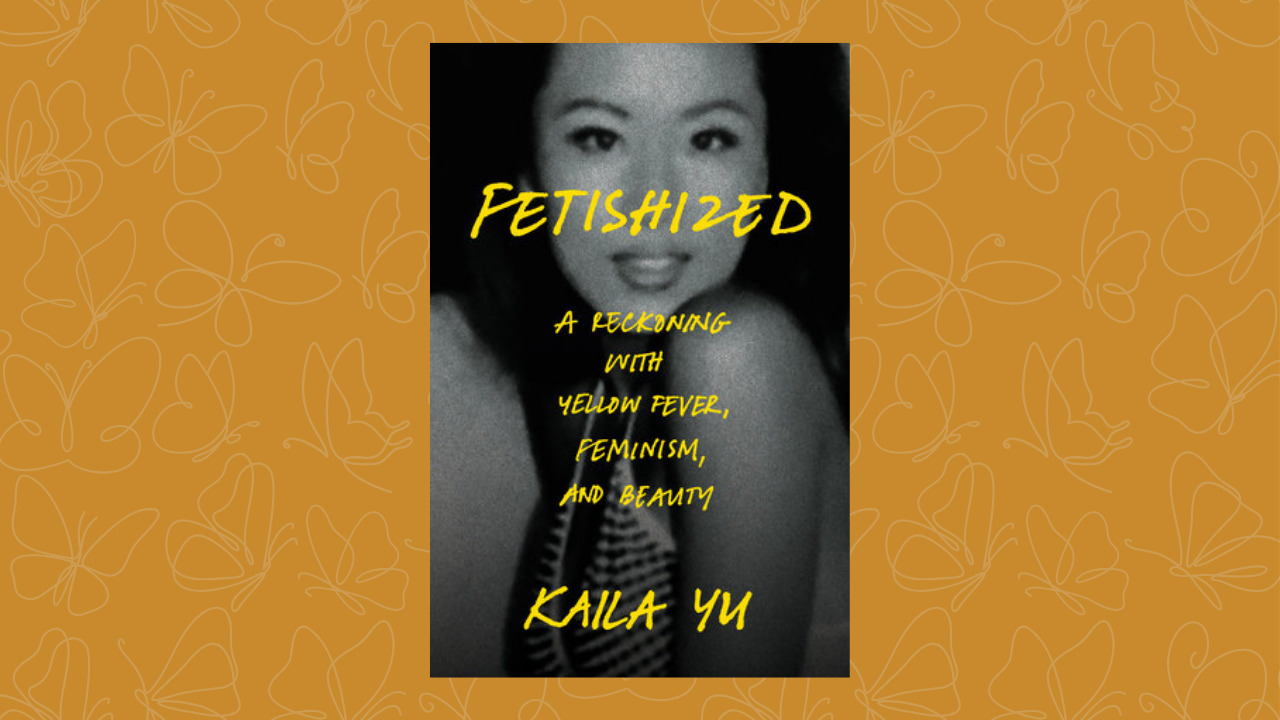
“The craziest thing about the Asian fetish is how confidently men announce it, with absolutely no shame and a good measure of pride,” writes Kaila Yu, author of Fetishized: A Reckoning with Yellow Fever, Feminism and Beauty, at the start of her compelling memoir.
What feels like a jarring claim is a stark reality that Asian women still face in today’s polarizing climate.
Written with vulnerability and unabashed honesty, Yu interweaves a series of personal essays about her life and takes readers on a personal journey about the systemic impacts Asian women face, specifically fetishization.
Fetishized is a candid sharing of Yu’s experience navigating “yellow fever” as a young woman, which bleeds into her career as a pin-up model, actress and singer. Yu deftly explores the historical roots that contribute to the sexualization of Asian women – misogyny, anti-feminism, and colonization – through detailed accounts of her life and career.
In almost every chapter, she recalls harrowing experiences, navigating brazen encounters with powerful, white men who casually utter disparaging, sexually explicit or violent comments to her, in person and online.
Throughout each chapter of the memoir, these alarming encounters increase, resulting in a sexual assault that Yu navigates as a teenager. A trauma that was viciously recorded and distributed online without her consent – a searing reflection of the normalization of violence that Asian women often navigate – while simultaneously being silenced, erased or dismissed.
The struggle for authentic representation of Asian women in media
Throughout Fetishized, readers will feel the frustration and tiredness that Yu experiences as she articulates the harmful impact of the systemic subordination of Asian women in North America, specifically in the chapter titled “Not Lucy Liu.” Here, Yu reminds readers that Asian women are first and foremost viewed as sex workers, designed and easily discarded to comfort (White) men. A role that traces its origins to sexual slavery that Asian women were violently forced into during the U.S. military occupation of Asian countries or the Pacific Theatre during World War II.
It is worth noting that through the Western lens, this term historically was and still is, gently referred to as “comfort women,” diminishing the violence that generations of Asian women truly endured.
Decades later, the impacts of these flat tropes were cemented by Hollywood in the 20th century through caricatures such as “butterfly,” “china doll,” and “dragon lady.” These typecast roles created an impossible situation that handed Asian actresses at the time a double-edged sword. It reinforced Asian stereotypes by landing major roles and generating breakthrough success, or missing out on career opportunities by maintaining integrity.
A conflict that Yu grappled with when she tried to transition from modelling to more serious acting roles beginning in 2002, when she was cast for the role of a stripper in the film Dark Blue, starring Kurt Russel. She landed a small cameo in 2006’s The Fast and the Furious: Tokyo Drift but merely as background scenery where Asian women appeared on the sidelines as objectified props. For Yu, transitioning to acting was a necessary next step for pinup models to gain respect: “I continued auditioning for various iterations of the Asian sex worker, with the stray Asian reporter or kung fu fighter thrown in. It was the bulk of what was available for Asian actresses then,” she shares in the memoir.
Navigating self-worth and complicity
The most powerful chapter lands halfway through Fetishized, when she acknowledges with candor, how she became a willful participant in the fetishization of herself. Ironically, being fetishized, the subject matter of her book, becomes the focal point throughout her multi-hyphenate career as a pin-up model, actress and singer. In the chapter “Slanted,” she writes:
“Media and pop culture convinced me that fetishization was the key to validation. So, I sacrificed everything to achieve that ideal. My kowtowing to the performance of Asian fetish kept me distant from my sexual desire… Each time I let the blade cut my flesh was to fix something I imagined would be unappealing to men. I’d mutilated my eyes, breasts, and vagina in a quest to find power as an object of desire… Instead, my true self was erased…”
Yu’s astute reflections hearken to renowned feminist critic, activist and scholar, Bell Hooks’ seminal essay, Eating the Other: Desire and Resistance, which explores how White men commodify and consume racialized cultures, specifically women, for their own pleasure and excitement.
Throughout Hooks’ essay, she highlights the concept of “Othering” and notes the stereotypes inflicted upon racialized women and how it becomes cemented through the lens of white patriarchy, which perceives “non-white people” as having “…more life experience… [were] more worldly, sensual, and sexual because they were different.” Hooks adds in a later part of the essay, “…the presence of the Other, the body of the Other, was seen as existing to serve the ends of white male desires,” which reflects the painstaking recollection of Yu’s entire fetishized existence through the lens of white patriarchy.
The impact of European colonization on Asian countries and the bodies of Asian women has created a violent impermanence with devastating impacts – including the 2021 Atlanta Spa shooting.
Yu’s harrowing memoir is a powerful reckoning about a woman reclaiming her self-worth and confidence after decades of internalized racism, misogyny and hypersexualization both inflicted upon and enacted upon her. It’s a story about the pervasiveness of Asian fetish and “yellow fever,” despite the post-#MeToo movement and a slowly shifting Hollywood landscape that celebrates diversity, equity and inclusion.
It’s both a lesson and a caution to society that we – collectively – all participate in the fetishization of Asian women. The power dynamics are imbalanced, with white, patriarchal men benefiting most from their sexual desire of a degrading obsession, while Asian women are on the receiving end of this dehumanizing perception, which can result in violence being enacted upon them. At the same time, Asian women can “lean into fetishization,” as a product of internalized racism, that it’s merely a “compliment” to be seen as desirable.
Admittedly, this complexity is something that Yu reveals towards the end of her memoir. In the chapter “A Reckoning”, she shares, “Most Asian women hate the Asian fetish. I spoke out derisively about it in public, yet in private chats with Asian girlfriends, I might say, ‘Well, obviously Asian girls are the best, there aren’t any fetishes about any other ethnicities of women, are there?’”
She recognizes that she uses the Asian fetish to her advantage and secretly enjoys it when it benefits her, “co-opting it for profit and personal gain…” It’s nuanced, complex, and brutally honest.
Rediscovering her identity
At its heart, Fetishized is a story about survival in a world that didn’t accept Asian women unless they objectified themselves to serve the male white gaze. It’s a personal analysis of how the systemic intersections of misogyny, colonization, and patriarchy contribute to reductive tropes and stereotypes of Asian women and how this normalization can manifest into deep psychological impacts.
As Yu painstakingly recounts throughout her memoir, how hypersexualized roles became an unspoken requirement for Asian women as directed by white men contributed to a sense of inferiority and a lack of self-worth that Yu is slowly rebuilding in her now-forties.
The early 2000s landscape was unforgiving for racialized women. Asian women lacked narrative autonomy and self-objectified themselves as a means of survival in an industry that refused to see them beyond “othering.”
In recent years, the Hollywood landscape has slowly shifted with gradual efforts in celebrating BIPOC voices throughfilm, television, and music. The last decade has seen an emerging proliferation of projects featuring more robust Asian casts in autonomous, non-stereotypical roles, a stark contrast to the oppressive 2000s landscape that Yu and her counterparts were dealt with, as a means of survival.
Readers will find Yu’s memoir compelling – at times, heartbreaking – as she grapples and comes to terms with how Asian fetishization continues to shape her relationship with herself, her body and self-worth.