Addressing Asian men’s mental health from experts and community leaders
While awareness around mental health has grown in recent years, many Asian men disproportionately continue to navigate challenges in seeking help.
Cultural stigma, language barriers, and a lack of culturally responsive care often prevent many from receiving the support they need. From the pressure to provide and succeed to the expectation of staying silent through hardship, these messages can make it difficult to seek support, express emotions, or ask for help.
These challenges are compounded by broader barriers to care. Asian Americans are among the least likely racial groups in the United States to seek mental health services despite experiencing mental health concerns at rates comparable to the general population
At the same time, loneliness has emerged as a growing public health concern. In 2023, the U.S. Surgeon General declared loneliness and social isolation a public health epidemic, linking chronic isolation to increased risks of depression, anxiety, cardiovascular disease, and premature mortality
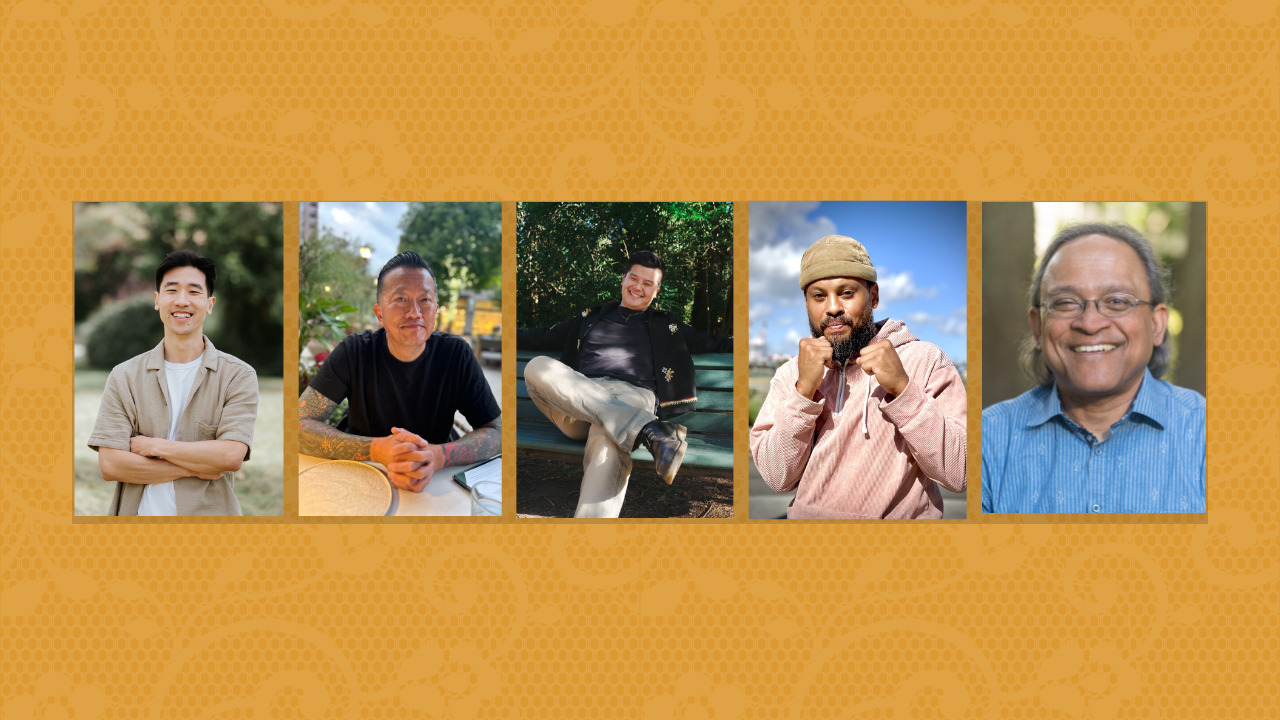
To better understand the current state of Asian men’s mental health, Cold Tea Collective spoke with therapists, coaches, facilitators, educators, and community leaders working directly with Asian men across the country. Special thanks to Leo Xia (Lowhi), John Santos, Samuel Shin, Dr. William Ming Liu, and Dr. Ravi Chandra for sharing their time, expertise, and personal reflections.
Their stories reveal both the challenges Asian men continue to face and the growing movement toward healing, connection, and community. While their backgrounds and experiences varied, one theme surfaced repeatedly: healing doesn’t happen in isolation. It happens through community, connection, and belonging.
See also: How Pan-Asian communities find connection through play
The hidden weight of expectations for Asian men
One of the biggest misconceptions surrounding Asian men’s mental health is the belief that success protects people from struggle.
Samuel Shin, a licensed marriage and family therapist, certified personal development coach, and men’s work facilitator, says many Asian men have checked off all the boxes they were taught to pursue.

“A lot of Asian men have checked off boxes of what they’re ‘supposed’ to do: career, finances, family. So they think they are happy and should be more grateful. But inside, they often feel empty, unfulfilled, and struggle with lots of insecurity, negativity, and doubt, ” reflected Shin.
Dr. William Ming Liu, professor and chair of the Department of Counseling Psychology at the University of Maryland, believes the model minority myth continues to play a significant role in how Asian men’s mental health is perceived.

“My sense is that the general public believes that Asian American men are free from many mental health issues largely because of the model minority myth,” said Dr. Liu.
That perception can make it harder for Asian men to acknowledge their struggles and easier for others to overlook them. Leo Xia, founder of Proud Asian Men and facilitator with the Asian Mental Health Project, often sees Asian men tie their self-worth to achievement and productivity.

“A lot of us grow up with a very conditional understanding of what love is. You need to do, achieve, acquire, and then you can get love,” said Xia.
When careers change, relationships end, or grief enters their lives, many are left questioning who they are beyond what they can accomplish.
See also: Breaking free from the model minority myth as a neurodivergent Vietnamese American
Asian men’s mental health: Loneliness beneath the surface
While depression and anxiety are frequently discussed, loneliness emerged as one of the strongest themes across every interview.
Xia believes many Asian men want deeper relationships but often lack spaces where vulnerability is encouraged.”A lot of Asian men want deeper bonds with each other, but not really having the spaces or the skill sets to really maintain them,” said Xia.
For John Santos, founder of Golden Shore Boxing in Long Beach, these struggles often show up in the gym.”Men working incredibly hard to stay regulated—not for themselves, but so the people around them won’t see their pain,” shared Santos. We explode, or we implode. Either one changes the direction of a life.”

For psychiatrist and writer Dr. Ravi Chandra, connection remains central to healing. “Relationships are the highest form of spiritual practice.”

Whether through friendship, community, family, or professional support, meaningful relationships remain one of the strongest protective factors for mental health.
How Asian men can redefine masculinity and strength
As conversations around mental health evolve, many Asian men are also redefining what masculinity means to them.
Research suggests that rigid masculine norms can discourage help-seeking behaviors and contribute to poorer mental health outcomes.
Shin notes that many of the men he works with struggle with identity, emotional regulation, and the balance between cultural expectations and personal fulfillment. “The most common mental health issues I see are struggles with race and Asian American identity, being stuck between cultural expectations and personal happiness, emotional regulation problems, and conflicts in relationships,” he shared.
He believes that vulnerability is not the opposite of strength. “The capacity to be vulnerable without shame and to stay rooted in healthy masculine energy is something our world is missing.”
Similarly, Santos believes accountability means showing up for ourselves and others in meaningful ways.”Showing up for others. Not always in the ways you’re used to. Not always in the ways that are comfortable. In the ways that are actually needed,” said Santos.
See also: Watchlist: ‘Beef’ forces us to face our shame
Why community matters for Asian men’s mental health
Throughout every conversation, community emerged as a critical part of healing.
After navigating anxiety, depression, and addiction earlier in life, Shin found that culturally responsive practitioners transformed his own healing journey and inspired his work supporting Asian men today.
“Belonging to me, first, is an inward journey of authenticity and self-acceptance,” said Shin.
Chandra believes belonging is a verb and encourages Asian men to continue investing in relationships and emotional growth. “Practice kindness and relationship. Feel all your emotions, from anger to joy.”
See also: Leonard Lim: Creating space for Asian men in fashion
Optimism despite challenges in addressing Asian men’s mental health
Despite ongoing challenges, each contributor expressed optimism about the future of Asian men’s mental health.
“I’m seeing people show up to groups more,” shares Leo Xia.I’m seeing Asian men want to be part of building something larger than themselves.”
Shin points to younger generations who are growing up with greater exposure to mental health conversations. “They are much more emotionally intelligent than my older adult clients.”
Dr. Liu finds optimism in the growing willingness of Asian American men to engage in difficult conversations.
For Santos, seeing others push the movement forward inspires him to continue the work. “Someone else’s courage to push forward made me want to do the same,” shared Santos.
Increased visibility itself is progress.”There’s a lot more visibility and talk about mental health and belonging,” notes Dr. Chandra.
For many Asian men, healing may begin with a simple but transformative realization: you do not have to do it alone. As these stories and more remind us, strength is not measured by how much we can endure in silence. Sometimes strength is reaching out, staying connected, and allowing ourselves to be seen.
See also: WATCHLIST: 15 Pan-Asian films centering mental health experiences
Mental Health Resources
- Asian Mental Health Project
- Asian Mental Health Collective
- Proud Asian Men
- Waking Dragons
- Yellow Chair Collective
- Permission to Come Home: Reclaiming Mental Health as Asian Americans by Jenny Wang
- Where I Belong: Healing Trauma and Embracing Asian American Identity by Linda Yoon and Soojin Lee
- Sunmoonlight Substack
See also: Dear Kiki: How do I stop feeling guilty about going to therapy?