*Disclosure: Cold Tea Collective serves as the publicist for COFU Chinatown and HUSH Coffee Store by COFU, the subjects of this article.
Chef Akiko Gulkison heads one of the world’s only plant-based omakase restaurants
April is not only my birthday month, but 2026 also marks eight years since my transition to veganism. So when COFU Chinatown invited me to try the Spring omakase menu at its Vancouver Chinatown location, I was ecstatic. I hadn’t yet dined at the restaurant since it opened in the summer of 2025, but I’d been to its original sister restaurant, COFU Pressed Sushi. And I’ve tried several dishes from its food trailer, COFU Vegan Ramen, at events by The Vegan Market.
I can only describe the eighteen-course, two-hour experience as a culinary symphony.

I’m not new to omakase (meaning “I leave it up to you”). In 2012, my mother-in-law’s friend treated me to a 30th birthday dinner at Kyubey, an exclusive 15-seat restaurant in Tokyo that has hosted Hollywood celebrities. In the middle of the meal, the chef held up a live jumbo shrimp and said in Japanese, “Live, or boiled?”
I turned to my husband (then boyfriend), who translated for me, and I politely asked for the poor animal to be boiled before consuming it.
So I had a memory to compare this to.
COFU’s omakase menu includes 17 courses, with an optional seasonal mushroom handroll, served after the nigiri portion. The omakase experience also means that seasonal ingredients may change without notice, meaning that each dining experience may be different.
Setting the table for omakase

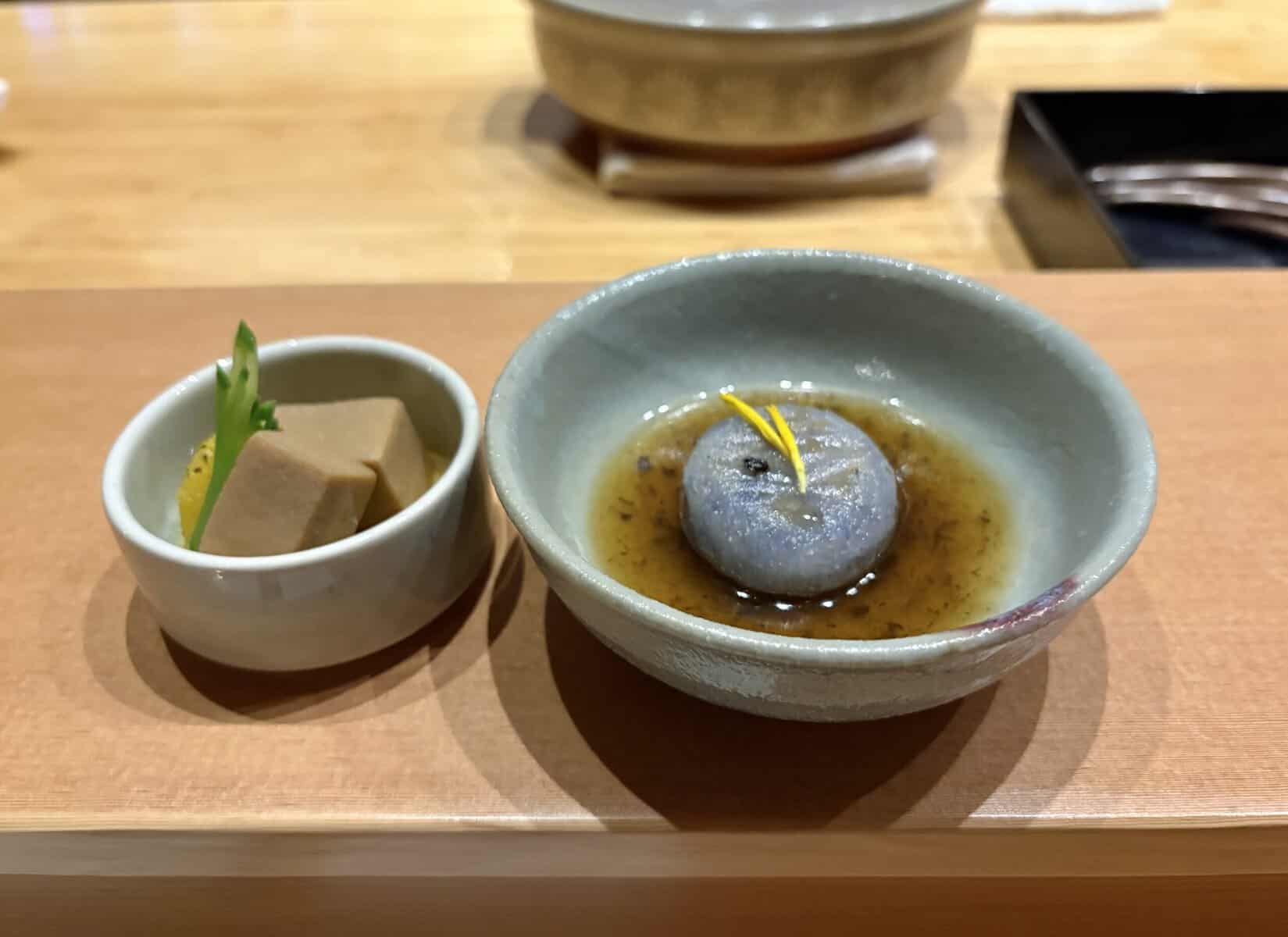
The first two appetizer dishes were daikon mochi with truffle sauce (right) and koya-dofu with shojin dashi, orange oil, and green peas (left). Like the part of a symphony when you hear the orchestra tune their instruments, these two dishes set the tone for what was to come: earthy, subtle, and traditional Japanese flavours. My tongue sang at the taste of the truffle infusion.
Throughout our meal, COFU Chinatown’s knowledgeable general manager, Riku Kurosaka, explained a bit of the culinary history behind some of the dishes.
“Most sushi chefs are men because in Japan, they believed women had higher temperatures and this would affect the temperature of the rice,” he said. That’s probably why you don’t see many female sushi chefs in [Japan] or even outside the country.
The two appetizers were also from a time in history when most people ate a vegetarian diet.

Dishes three to five included a steamed soy milk custard, one soup course, and a vegetable skewer. I’d never tried the custard dish before—topped with irizake (made from Japanese plum and sake), the flavours were new to me.
The clear soup was a shojin dashi with shiratama, a rice dumpling at the bottom. It included vegetable trimmings and kitchen peels—I swore I could taste a bit of citrus on my last sip.
These two dishes were a nice build-up to the grilled vegetable skewer, a seasonal vegetable wrapped in seasoned soy protein, finished with house-made teriyaki sauce. Chef Akiko Gulkison said she used red kidney beans in the protein, which gave the entire bite a meaty texture. We were definitely into the first movement of the meal.
See also: Plant-based adobo: embracing Filipino veganism
Chef Akiko Gulkison’s story
Arriving in Canada from Japan in 2018 as a single mother of three, Gulkison was determined to build a new life. While attending aesthetics school in Vancouver, she worked in sushi restaurants despite an invisible physical disability.
In 2021, she pioneered a bold concept rooted in traditional Japanese techniques, expressed through Canadian ingredients, and contemporary insight: COFU Pressed Sushi, Vancouver’s first plant-based sushi restaurant.
Her vision was unconventional: plant-based pressed sushi that honoured craftsmanship while challenging assumptions about vegan cuisine. “People think of veganism as restriction, but in Japanese philosophy, we see it as the marriage of restraint and contentment,” she shares.
In a city already known for Japanese food, Gulkison focuses not just on flavour but on experience drawn from what genuinely captivates guests. It’s no wonder COFU Chinatown was the next expression of her creativity and values.
“We are not trying to emulate the texture of meat, but instead use different cooking techniques and flavours to make great-tasting plant-based Japanese food,” she continues. “I’m not pushing people to be vegan, but if people can choose only one day a month to understand Japanese or vegan food, it helps the world just one day. That’s a beautiful moment I can see every night—it makes me so happy.”
Mentoring future female Japanese cuisine chefs
Gulkison was featured in Season 1, Episode 3 of CTV Life Channel’s Evolving Vegan, hosted by vegan actor Mena Massoud (Jack Ryan, Aladdin).
She’s passionate about providing employment and mentorship opportunities for other female sushi chefs, and was excited to share that she was training Maki Hirai to become COFU’s second female sushi chef.
Since 2017, Hirai has worked at Minami, The Victor, Miku, and Sushi Jiyujin Ltd., where she has overseen large-scale catering operations at Rogers Arena. She even returned to Japan in 2021 to complete a rigorous program at a specialized sushi academy.
Gulkison joked that Hirai was in Japan last month training as a vegetable “sommelier.”
See also: Chef Eva Chin on Reclaiming Culture and Identity Through Food
Plant-based nigiri seven ways
Nigiri I to III included potato and seasonal vegetables, sakamushi shiitake and peach, and radicchio kobujime. My favourite of the three was the shiitake mushroom with peach, a delightful dance of texture and contrasting flavours.
Instead of a slice of raw or cooked fish pressed over a small, hand-formed mound of vinegared rice, the seven nigiri were all variations of vegetables or mushrooms. COFU Chinatown’s General Manager, Kurosaka, explained that nigiri could also be eaten with your hands.
Nigiri I to III included potato and seasonal vegetables, sakamushi shiitake and peach, and radicchio kobujime. My favourite of the three was the shiitake mushroom with peach, a delightful dance of texture and contrasting flavours.


Unlike our Western sushi preferences, there is no soy sauce accompaniment with nigiri, and rightly so. You have the option of removing the dab of wasabi (a spicy, pale green condiment made of root vegetable) that the chef normally adds, and the ginger served on the side is meant to be a palate cleanser between bites.
Nigiri IV was a carrot millefeuille highlighting sweetness and structure. This was a showstopper among all the guests, who could taste the smokiness of the carrot that was—dare I say—even better than smoked salmon.
Instead of the fifth bite being a nigiri, the eggplant miso with snow fungus was a gunkan, a hand-formed, oval-shaped ball of rice wrapped in a tall strip of nori seaweed—the most common type of sushi most recognize. The addition of the snow fungus and seaweed offered a nice texture contrast to the bite of eggplant.
While most omakase focuses on seafood, I loved this subtle tribute to the plants of the sea. We were into the second movement of the meal now.
Vegan Japanese entrées
The eleventh dish, comprising an intermission, was a miso soup and tsukemono: house pickles made of cucumber, soaked in sake.

Our mouths watered as we saw Akiko torching Nigiri VI, grilled eggplant. Tender and smoky, this was another showstopper of the evening, followed by Nigiri VII, oshibana with daikon. If you like bitter flavours, shiso (perilla) is a nice tease on the tongue, marking the end of the third movement of our culinary symphony.
The 14th course was ochazuke or “sushi rice risotto.” The rice is finished with warm tea broth, marking the end of the entrée portion of the omakase. While Gulkison added a crispy daikon chip and a fried piece of mushroom on the side for texture, this was only the start—she suggested adding a bit more tea and a pinch of salted matcha (green tea) powder.

Gulkison sources most of COFU’s ingredients locally—even from vendors as close as across the street—but her matcha is special, from a street vendor in Kyoto with whom she grew up.
Ending the special omakase with vegan dessert
Marking the fourth movement of the omakase was a trio of desserts: matcha sponge cake with housemade sweet beans, seasonal sherbet, and confection for tea matcha. Mimicking the subtlety of the start of the meal, these were not cloyingly sweet dishes, but grounded.
The beet sherbet might be the best sorbet I’ve tasted, pairing the earthy beet flavour with just enough tartness, and the smoothest texture I can remember from an icy dessert. While the house-crafted jewel-like kohakuto (crystal vegan jelly candy, served on an impressive, bendable tin plate) might have been the sweetest thing on the menu, the sips of matcha tea were a perfect balance and end to the culinary performance.

During the meal, my husband tried several selections from the extensive sake menu. The 6 oz servings overflow from the glass into a wooden box, adding another depth of flavour when you drink from it.
A 2 oz. sake pairing is also available with the omakase ($48).
Rounding out the vibe were hip, female-sung lounge tunes courtesy of Derek Gulkison, the head chef’s partner in life and business.
Visit COFU Chinatown
COFU Chinatown is the only restaurant in Canada to offer a plant-based omakase. It has built a loyal following among locals and international visitors alike.
Within a year of its opening, it was a finalist in Vancouver Magazine’s 37th Annual Restaurant Awards in two categories: Readers’ Choice: Best Plant-Based and Best Chinatown.
While a regular dining menu is available, you’ll definitely want to make a reservation for the omakase ($130pp CAD, not including tax, gratuity or beverages) to experience not just luxurious plant-based dining, but the soul of Japanese cuisine. There’s nothing else like it in the city.
COFU Chinatown is at 488 Gore Avenue in the heart of Vancouver’s Chinatown, open Sundays, Wednesdays, and Thursdays from 5 p.m. to 10 p.m., and Fridays and Saturdays from 4 p.m. to 11 p.m.
Inside COFU Chinatown also stands HUSH COFFEE STORE by COFU. Open on weekends from 9:30 a.m. to 2:30 p.m., HUSH features a plant-forward menu of coffee, tea, house-made sweets, with a brand new plant-based brunch menu starting April 4.
With coffee beans from Vancouver-based Japanese roaster Hiyori and matcha and hojicha drinks made from ceremonial-grade Uji tea from Kyoto, HUSH COFFEE STORE also serves alcoholic and non-alcoholic cocktails for those who prefer a more spirited start to their day.
*Disclosure: Cold Tea Collective serves as the publicist for COFU Chinatown and HUSH Coffee Store by COFU, the subjects of this article.