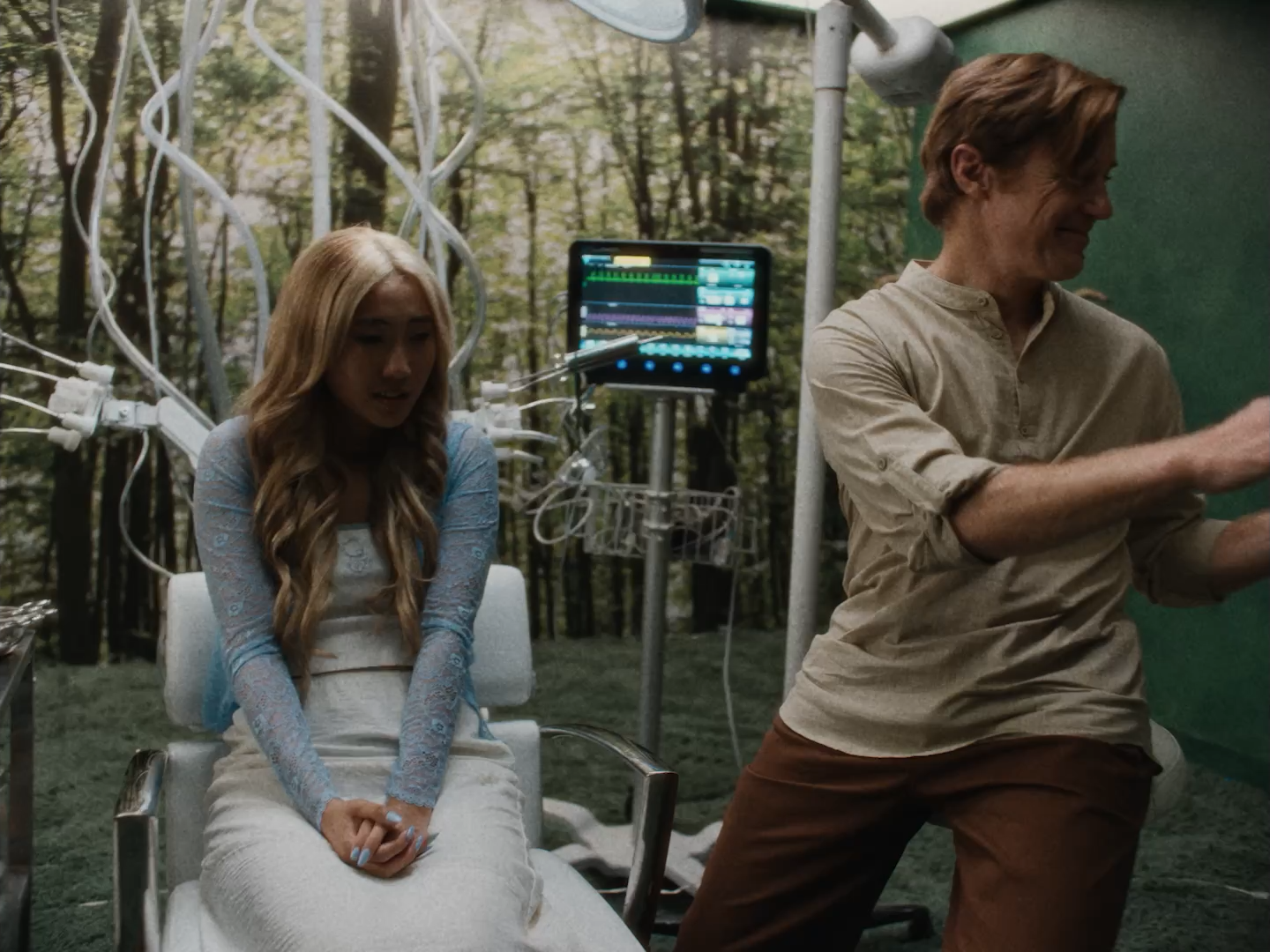
I first discovered Slanted while working on a piece for the Hawai’i International Film Festival. The movie’s premise really stood out to me — a body horror satire about race and identity. The film’s protagonist, Joan Huang, undergoes a permanent surgery to change her appearance from Chinese to caucasian. She wants to become the prom queen, and how does one become a prom queen? They become white. I immediately added it to my Letterboxd watchlist and was thrilled when I learned it had been picked up for a wide theatrical release.
As a mixed-race, ethnically ambiguous Japanese Hawaiian American living in Japan, I ponder about identity and the concept of belonging daily. I grew up in the US and have lived in France and the UK, but I have never experienced what it’s like to fully stick out and be ostracized for looking different in a place that is supposed to be my home — until I moved to Japan.
Although I have Japanese ancestry from both sides of my family, I am an immigrant in Japan, which is why Slanted left such an impact on me as a viewer. I, like Joan, live in a society that has its own rigid ideas about who belongs — but I, unlike Joan, am proud of who I am.
A film for everyone
When I told Slanted director Amy Wang that her film had had a profound impact on me and helped me fully understand the experiences of my Asian diaspora husband, friends, and family, she lit up. As a filmmaker, she intended to make this film for everyone (especially the Asian diaspora community), but her answer for who she most wanted to watch it was unexpected:
“If I had to say one person whom I want to watch the film, it would be an old man from the south, in a tiny town. I feel like that would be incredible, because I think film is all about transcending where you come from and seeing a different story from a different perspective, so far away from what you’re used to. And that’s the power of film.”
For those of us in the Asian diaspora, the impact is something else entirely.
The stifling, omnipresent environment of white America
In the background shots of the high school Joan attends, audiences see an image of a man in a tall white pointy hood throughout the halls. “Y’all Klan?” one might think (this is a reference to Sinners, if you know, you know). However, upon closer inspection, the figure is a wizard wearing a tall white hat, and he is the school’s mascot.
The school mascot in Slanted isn’t just a background detail; it’s part of the film’s argument, one that Wang makes relentlessly throughout the entire movie. Everywhere Joan looks, she is reminded of what she is not — white.
She lives in a small town where blonde prom queens line the hallways of her school, the popular kids are white, and people of color work in service jobs. And as a child, Joan’s classmates taunted and bullied her for being Chinese.
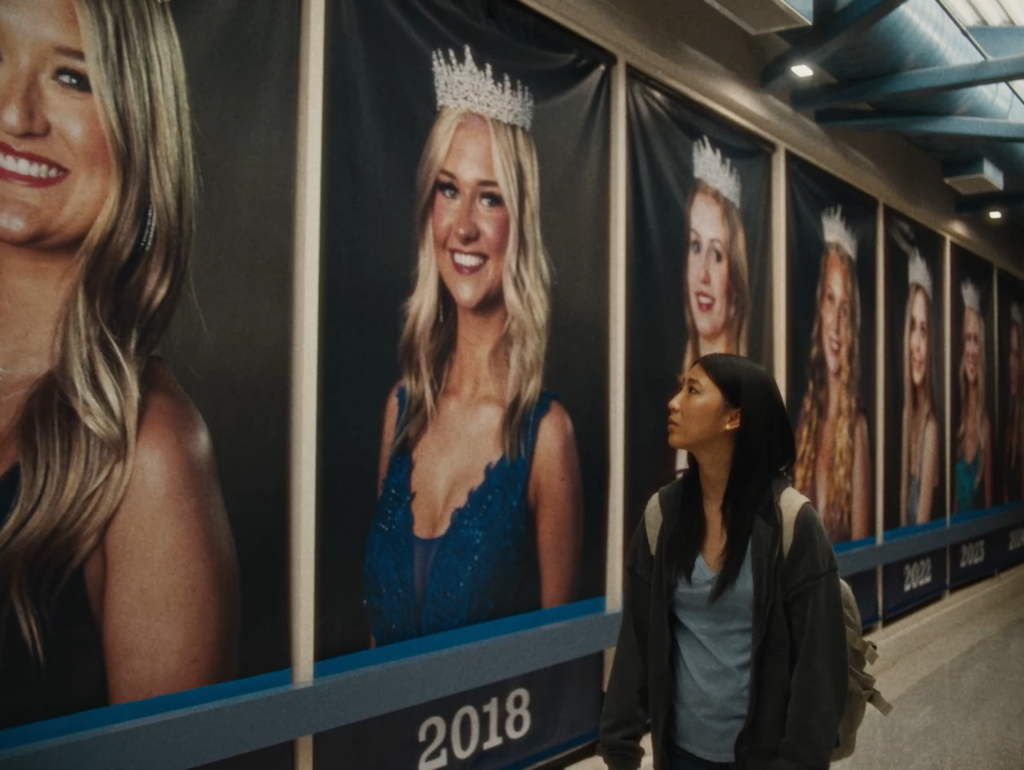
Whiteness is not just a theme in this film; it’s baked into the atmosphere, suffocating both Joan and the audience. When I asked Wang about these choices, she pointed to something larger than just one country:
“More so than any other country, I think America has really spread its roots across the world. In Australia, I grew up watching American movies, knowing about Hollywood, watching American TV shows — pop culture is really quintessentially American. So it was a lot of fun to be able to poke fun at those things.”
For Wang, America wasn’t just a setting. It was the most recognizable background for a story about what it costs to belong.
Rejecting the dragon parent trope
Unlike other films that feature Asian parent-child relationships, which often portray tiger moms and impossible expectations, Joan’s parents felt startlingly kind and loving toward their daughter.
Given that Slanted was inspired by Wang’s personal experiences growing up as an immigrant in Australia, Joan’s parents (played by Fang Du and Vivian Wu) were inspired by Wang’s own mom and dad.
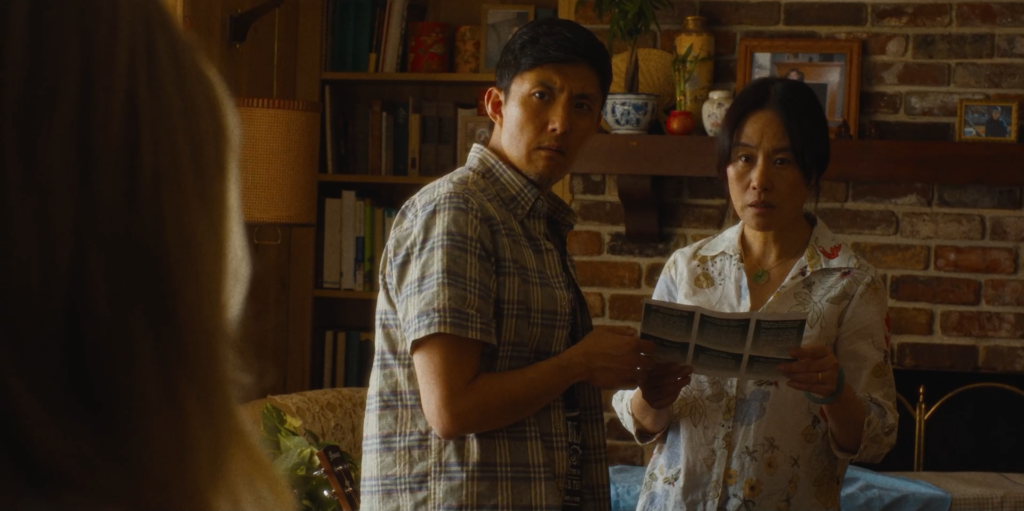
While both sets of parents were very supportive and grounded, they had immigrated in their 30s and already knew who they were. Whereas Joan and Amy were children who faced difficulty integrating with their peers and dealt with racist consequences, their parents could not understand.
“It was such a strange kind of duality that I had to balance.”
It’s a tension that many children of immigrants will recognize — the loneliness of navigating a world your parents never had to, in a body that marks you as different before you’ve even opened your mouth.
See also: How I forgave my Asian parents
What Slanted says out loud
Some scenes hit you immediately and really pack a punch. In Slanted, there were three that did that for me:
- Joan’s friend Brindha (Maitreyi Ramakrishnan) asking Joan if she thinks she’s ugly, too, after Joan undergoes the surgery,
- Joan’s dad telling her he can’t see the Huang family in her face anymore, and
- Joan declaring that she doesn’t have to be Chinese American or Asian American — she can just be American.
That last one stayed with me in a different way than the others. Being Japanese American and Asian American feels extra special to me; it’s always an additional layer of identity that I carry with pride. But unlike Joan, I was always a default American first. Joan wanting to shed that specificity and just be American really opened my eyes here — to my own privilege of being ethnically ambiguous and the burden that people who are not ambiguous have to carry. For her, it was a suffocating existence, but for me, it’s a gift that makes me special.
Of all the lines in the film, one of the most devastating was Joan’s dad telling her he can’t see his family in her face anymore. It’s the moment where the cost of Joan’s decision starts to fully take weight. It’s about a father looking at his daughter and seeing a stranger. Joan didn’t just erase her face and herself; she erased her family lineage and ancestry and everyone who came before her.
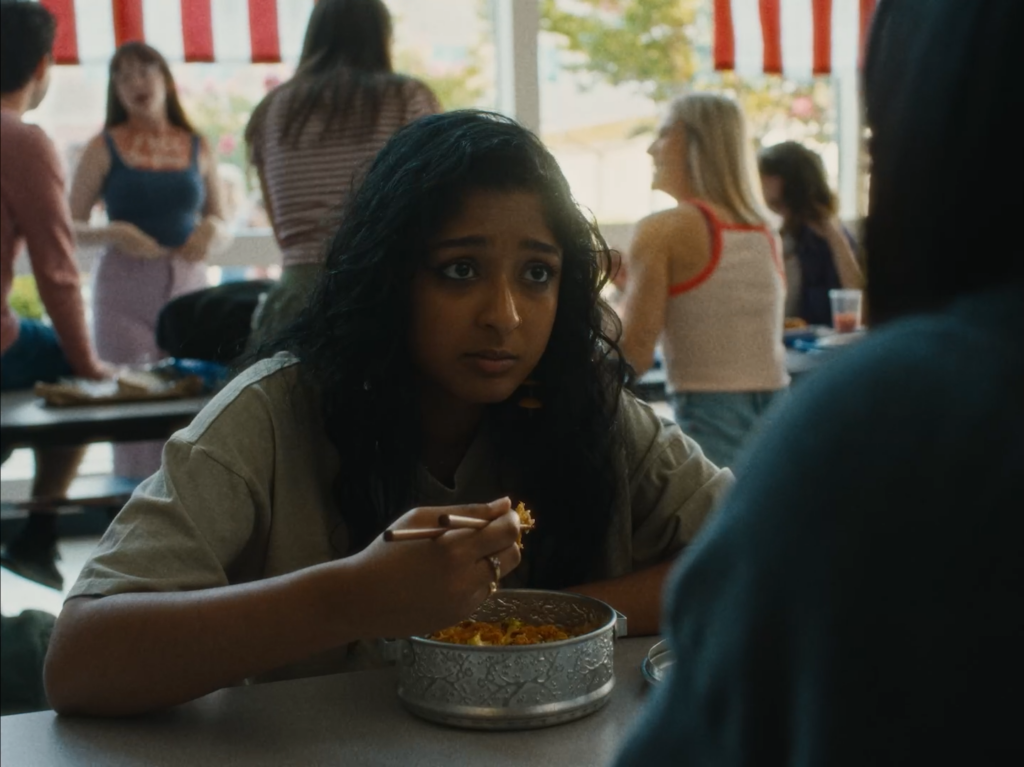
Meanwhile, Brindha’s epic and humbling line about being ugly almost didn’t exist. It wasn’t in Wang’s original script — it was Maitreyi Ramakrishnan’s own idea, brought up during a Zoom call before filming began. Wang shares, “I remember Zooming with Maitreyi, and she brought that scene up and said she felt like there was something else in there, maybe another line. She suggested it, and I was like, ‘That’s perfect, that’s an incredible idea.’ And she nails it. I’m just really fortunate that so many people felt so deeply for the characters that they were able to add things like that.”
Being your own American
I live in Japan, where the social pressure to conform is so deeply embedded that it has its own proverb about conformity: deru kugi wa utareru (出る杭は打たれる) or “the nail that sticks out gets hammered down.” Changing yourself to fit into society is encouraged, nay, forced upon people in Japan, and what Joan did would have been celebrated here.
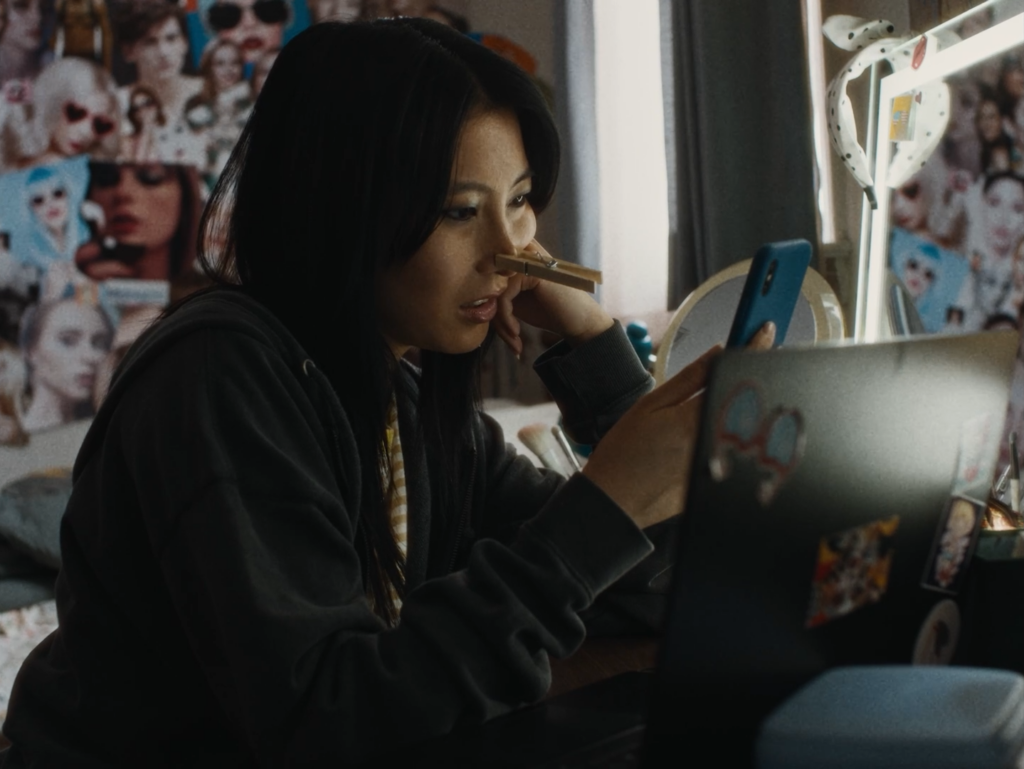
In a film like Slanted, where one takeaway could be that you shouldn’t change yourself to fit in, Wang reflected on the idea of changing yourself to fit in with the dominant community. She says,
“I think it’s inevitable to feel that you should change yourself. But I always think back to the line from the dad, who says, ‘you have to be your own American.’ I think there’s value in — even if you’re the minority in a dominant culture — figuring out where you sit and who you are individually, and being okay with that. What that looks like is different for each person, but finding what that is and believing in it — I think that’s the most important thing.”
Watching Slanted from Japan, as an American nail that does its best to follow societal rules but refuses to get hammered down, I found that I could truly relate. I am my own Japanese and I am my own American.
Slanted premieres in selected North American theatres on March 13, 2026.
See also: How dating my boyfriend helped me embrace my Japanese heritage