Only bearing a slight resemblance to 2006 award-winning graphic novel of the same name, American Born Chinese stands as a brilliant adaptation.
The television show, set for release on May 24, revolves around Jin Wang (Ben Wang), a Chinese American high schooler, who just wants to fit in despite his arguing parents, heavenly beings demanding his attention, and his own insecurities.
The creatives behind the Disney+ series took on an unusual adaptation strategy to spotlight relatable characters with resonance to the Asian American experience, which drew in a talented cast and crew.
A 10 year creative courtship
From the moment he read the graphic novel in 2006, producer Melvin Mar knew he wanted to turn it into a television series. Over the following ten years, Mar requested the rights to adapt American Born Chinese from author Gene Luen Yang. The answer every time was a polite “no.”

That is, until the two met in person. A couple months after Yang and Mar’s first conversation, Yang called Mar—Yang was finally comfortable letting someone adapt his work. Mar, overjoyed, brought Kelvin Yu, the mind behind Bob’s Burgers, on board as the showrunner to start work on the adaptation.
“The moral of the story is if you love something like that, wait it out. Hopefully things align and it’ll happen,” says Yang when reflecting on the decade-long process.
Given the task of spinning a 240-page graphic novel into eight episodes for television, Yu, Mar, and Yang decided to stray away from telling the story exactly as is in the novel, a usual adaptation strategy.
“Kelvin, Melvin, and I had a lot of conversations from the very beginning, and those conversations convinced me that these guys got what I was trying to do with the book,” said Yang. “It made me feel better about handing it over to them.”
The trio decided to “boil the novel down to its essence,” leaving a few central themes and characters which would become the basis of the television show. They decided to set the story in the 2020s instead of the 1980s.
Yang told Cold Tea Collective that the conversation around Asian Americans has changed a lot in those forty years and that it was important to them to showcase that change. As a result, the plot of the television show aligns modestly with the plot of the graphic novel.
Read more: Not your average superhero: Creating Asian representation with DC Comics’ Monkey Prince
Adapting across mediums
“Different media have different strengths. The adapter needs to understand the strengths and weaknesses of the original medium and the new medium, and Kelvin really does that,” said Yang.
He cited episode four, which draws inspiration from the heavenly party depicted on the first page of the graphic novel. The episode provides backstory that’s not shown in the novel, and yet it feels true to the substance of the source material.
When adapting the novel, Yu made sure to rely on some of the visual assets innate in television. For instance, the show includes plenty of fast-paced, flashy action sequences, something only really possible on the screen. Intentionally reminiscent of 1980s Kung Fu movies, these action-packed scenes do not feel out of line with the original story.
The TV show retains some of what worked best in the graphic novel, such as the interweaving storylines. The cast commented to Cold Tea Collective that at times it felt like they were filming four different shows, because in a way they were. The series contains a coming-of-age story, a family drama, a fantasy quest, and a 90’s sitcom.
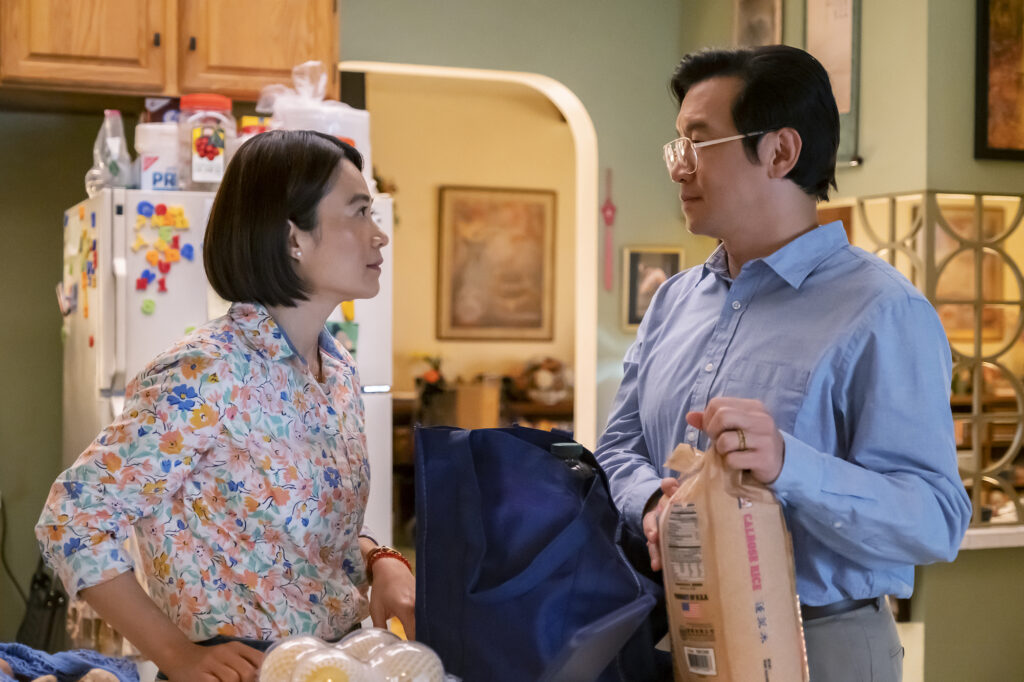
Perhaps the greatest addition of the show is the exploration of the relationship between parents and children. The highlight of the show is the strife between Jin’s parents, Simon (Chin Han) and Christine (Yeo Yann Yann), something absent from the source material.
Simon and Christine stand up for their family in front of the school’s principal in their storyline’s culmination. This scene demonstrates why Han and Yann Yann’s characters and stellar performances are necessary for the success of this show. Without understanding the parents’ struggles and past, the children’s problems feel ungrounded.
Yeo commented that finding only a singular panel of Jin’s mother in the novel provided her with creative freedom to develop the role in her own vision. Amidst a range of excellent performances from the entire cast, her performance with Han stands out in particular.
However, the TV series chose not to engage with some salient themes of the graphic novel. For example, the source material explicitly tackles the aspiration for whiteness among Asian Americans, something adapted differently in the show.
In Yang’s original, the climax lies in the realization that the story of “all-American” white Danny and outcast Chinese American Jin are the same. After becoming frustrated with his identity and his inability to fit in, Jin morphs into a white boy and takes on the persona of Danny.

Jin’s journey in the graphic novel revolves around his relationship with whiteness and the eventual realization that he can never be white and cannot escape his heritage—or the stereotypes that follow him. The broader message of the graphic novel becomes that the goal of “fitting in” (coded as being white, or the model minority myth per se) is inherently impossible.
At the end of the TV show, the audience left with the opposite feeling as the end of the graphic novel. Jin wins the heart of his white crush and gains the admiration of his classmates. The salient warning against the model minority myth in the novel was adjusted in the television adaptation to reflect a more current message for young Asian American audiences.
Read more: How Chinese superstitions influenced my mixed Asian identity
Assembling the stars
The story of how the cast came to be as star-studded as it is demonstrates the power of the source material and a majority Asian American work.
From the moment Ben Wang read the graphic novel, the depiction of what he felt was his own life captivated him.
“I remember reading it in the basement of the Westport Library with tears streaming down my face,” shares Wang. From that point onwards, he knew the role was a must for him.

A couple serendipitous moments lead to casting the (now) Academy Award-winning Michelle Yeoh and Ke Huy Quan. Upon Mar bringing director Destin Daniel Cretton into the project, Cretton called Yeoh to gauge her interest in the project.
Mar tells Cold Tea Collective that the next day, Yeoh emailed him. He admits to being starstruck upon receiving it, and soon, Yeoh was cast as Guanyin.
Mar explains that after becoming enamored with Quan following a three-hour Zoom call, the role of Freddy Wong (played by Ke Huy Quan) originated with him in mind. Wong, representing Hollywood’s history of marginalizing Asian Americans to inauthentic roles, is a clever on-screen translation for the overtly stereotypical (and intentionally so) character of Chin-Kee in the novel. Yu was able to include this inspiration in the show without externalizing it to an incredibly offensive or racist depiction.
Understandably, Quan was initially hesitant about the role. In many ways, Freddy Wong’s story touches on his own grievances with Hollywood and mirrors his own personal journey.
Daniel Wu had been offered many different iterations of the role of Sun Wukong (the Monkey King) from Journey to the West. What drew him to this version over the others was how American Born Chinese tells the next chapter of the Monkey King’s life, instead of simply retelling his epic exploits.

Moreover, as a father himself, Wu noted that the relationship between Sun Wukong and Wei-Chen excited him about the role and the show. Indeed, themes from the father-son duo help uplift the most crucial elements of the show.
For all the cast, the themes and characters of the show resonated with each of them, and the characters alignment with the cast’s lived experiences gave them additional fuel for their performances.
Read more: Asian Representation in Hollywood: Why So Late?
Making room for creative re-interpretation
American Born Chinese aims to create a conversation with the source material, rather than stay completely true to it. The two should be consumed together, and hopefully one sparks interest in the other.
Yang is correct that the conversation around Asian Americans has shifted, but that does not mean that the context of the 1980s is unimportant or irrelevant to the present day. The graphic novel is only more prominent now than ever and should not be overlooked because of the existence of a splashy television adaptation.
Feature photo: Disney+