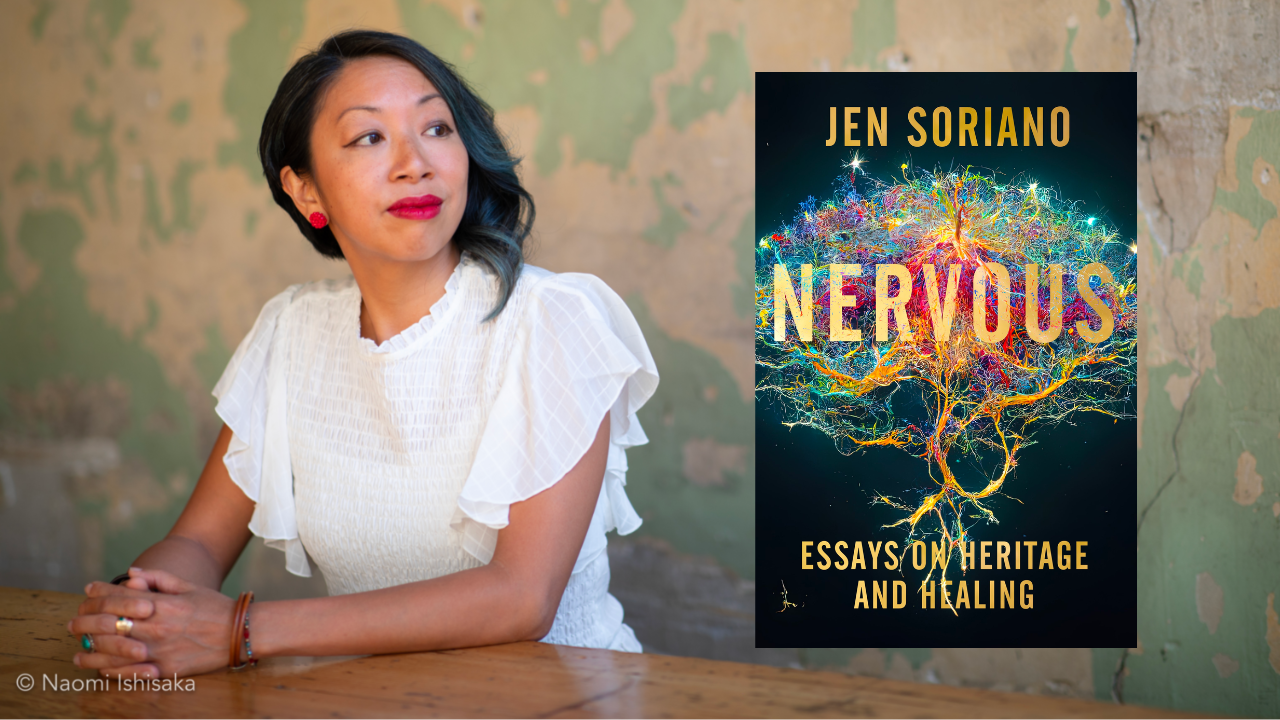
Nervous: Essays on Heritage and Healing by Jen Soriano brings to light the complexities of intergenerational trauma, unconventional healing modalities, and the crucial role of community and family in healing. Cold Tea Reads interviewed Soriano about what it takes to transform trauma individually and in a greater society.
Intergenerational trauma and personal healing
For Soriano, understanding her intergenerational trauma involved listening to her body and believing what was happening to it. “What would happen if we listened to our bodies and believed its stories?” She says, “That is really one of the book’s main messages.”
Tapping into somatic experiences challenges Western societal norms that often prioritize rationality over emotion and physical sensations. What presented as chronic pain in her body stemmed from a traumatic birth experience she later discovered as she was seeking relief. Soriano details her own embodied flashbacks: “I felt like I was a baby on my back and fighting for my life. I spread my arms, kicking my legs like I couldn’t get up.”
Additionally, Soriano’s exploration of her body also revealed connections to her grandfather’s experiences in the Second World War. “I was carrying some of the trauma of his loss [in my family], even some of the trauma that he went through in the war,” Soriano reveals. “I think it’s common for people with ancestral influences. But we just don’t necessarily talk about it, especially if you’re a woman of color, you get dismissed as crazy.”
Building her communities of care
In Nervous, Soriano emphasizes the creation of communities of care where wellness becomes a value practice. This approach involves helping each other with access to care and challenging the barriers created by societal and cultural dismissals of mental health issues.
In her healing journey, Soriano found solace in traditional practices and personal experiences. She speaks about the transformative power of engaging in practices like Imee Dalton’s kali container, a blend of Filipino martial arts and spiritual practice, which helped her channel her ancestral warrior lineage into something more artistic and healing.
“Community rituals brought me close to other bodies connected by shared purpose. Once I began to understand my own body as a body connected to others, I began to believe that my pain was not just my own. Once I started to believe my pain was not my own, I started to believe the pain was not my fault,” she shares in her book.
Soriano looks towards these communities of care where we’re checking in and helping each other with access. The community dimension is something we need to talk more about.
“Access to leisure time or self-care is subject to all these power dynamics [access that can be limited by class, race, gender] that we haven’t dismantled yet,” she says. “Collective care can fill in where opportunities for self-care might be limited.”
The revolution against systemic inequality
Soriano recognizes the systemic issues when she critiques the status quo, a short-term focus of current systems that overlook long-term public health and wellness investments.
“We must make a long-term investment in humanity, wellness and health. This is what I mean by the revolution of values,” Soriano shares. “Right now our nation’s values are all about economic growth and productivity under capitalism, but our values should be about investing in wellness even when it doesn’t contribute to the bottom line.”
Additionally, Soriano underscores the importance of increasing access to mental health resources because societal dynamics influence a person’s ability to get support.
Vulnerable communities often face socioeconomic factors like limited access to healthcare, insurance, and transportation. Undoubtedly, not having access to these fundamental services or mental health support have a greater impact on overall health than diets or exercise alone.
“I couldn’t just undo this pain and health issues by doing more core exercises,” Soriano says, “Like walking more or something. None of that stuff would get to the root of the issue.”
Shaping a trauma-informed society
Not pathologizing or ignoring the body’s sensations and emotions would be a step toward shaping a trauma-informed society. To create one, we must reform institutions like healthcare and education to be more trauma-informed and equity-based.
“What I was going through didn’t fit into a model like when you were in a car accident or if you broke your ankle,” Soriano says. “The kinds of responses I would get from practitioners was ‘it’s all in your head.’”
Plus, she advocates for community-level interventions that address the root causes of behaviors that may stem from trauma-based wounds. Soriano argues this approach is crucial to better support the well-being of vulnerable groups like children and caregivers, addressing the lasting impacts of adverse childhood experiences.
“We’re not a great country when it comes to the amount invested in policy practice and resources, supporting young people, and the people who are charged with caregiving. There’s this throw them to the wolves mentality and pull up your bootstraps. We all know that that’s not a successful model,” Soriano argues.
A call for collective healing
Nervous: Essays on Heritage and Healing is an introspective memoir that poignantly urges us toward a communal path of healing and comprehension. Soriano’s eloquent reflections beckon us to acknowledge our historical roots and their bearing on our present. She suggests that a profound grasp of our past can forge pathways to more empathetic and effective mental health and trauma interventions. Readers who delve into the pages of Soriano’s work will witness her compelling call to action and partake in the collective journey toward understanding and healing.
See also: David Bouchard’s “I Am Not a Ghost”: A Story of Resilience and Heritage